Showing posts with label US. Show all posts

Sunday, October 7, 2012

On the use of the Queen’s English.


Jonnie Comet
30 May 1997


  There have been some who question my use of British Commonwealth English, claiming that, for an American-born writer and scholar living in the late 20th C., and especially as an educator in language arts, I of all people ought to be embracing the usage of modern American English.  The fact is that for purely academic reasons I have been adhering to this usage almost exclusively since about 1972, except in those forums where Americentric instructors and those unable to recognise the Queen’s English forbade it (I have had PhDs in English literature ask me why I’d misspelt this way, not realising it might have been deliberate). Though it may leave me vulnerable to heated debate, particularly from anti-Anglo Americans, I can and do set forth my rationale in honest, reasonable terms.
  The first is that the English invented the language. Swift once advocated a ‘language police’ to correct errors and enforce spelling and mechanics, an idea upon which Dr Johnson obviously leaned in compiling his first English Dictionary in 1755. I confess I sort of like the idea– well, consider the alternative, which smacks of linguistic relativism. But then, openly despising all things English or European, Emerson advised his friend Webster to concoct an American dictionary in the early 19th C, in which all vestiges or Anglo- or Eurocentric usage would be ‘corrected’. In this heavy-handed anti-Anglo anti-dogmatism, itself hypocritically dogmatic, the idea of a deliberately deviant form of the language emerged. I would therefore submit that this typically Romantic (and American) rebellion has caused more confusion than good, and my next few points will support that.
  Next, the use of Commonwealth usage represents a more enlightened world view. Only the culturally ignorant would refer to British spellings and usage as ‘wrong’ and the American ones as ‘right’, when the United States is the only English-using society which deviates from the established English usage materially, such as in prescribed rules of grammar, spellings and pronunciations. If we are ever to unite this world by a common language, that language ought to be English, and not American English but the real thing. Consider, dear Reader, before you claim that America somehow outweighs England in all things considerable, that the largest English-speaking populace in the world is neither America nor England itself, but the Commonwealth Republic of India; and the Indians use British English. In numbers alone the original form must take precedence; for in fact, the total population of the world using British English in everyday discourse, occupying every continent of the globe, in writing as well as speech, outnumbers the Americans three to one.
  I may be American by birth and Italian at heart, but I am English by choice. My sensibilities are English, not American. Like a pre-1770s Colonial I see things through English precedents and do not subscribe to Emerson’s proud boast that the United States is somehow entitled to be culturally and linguistically superior to and insulated from England. For my life I cannot see how any thinking person can claim that. The British have been America’s staunchest ally, culturally, financially and militarily, since the first third of the 1800s and still own more real estate in America than any other foreigners. Further the entire institution of the American nation is predicated on English common law and the forerunners of English history, culture, architecture and philosophy. Refusal to accept this is akin to denying the genetic primacy of a parent. To contend that the United States could somehow exist entirely independent of England is rash, unenlightened and possibly even an indication that one is feeling ideologically threatened.
  The last justification is the most strongly held of all and hearkens back to Swift’s point. In all my pedagogical studies, especially in the English content areas, the gravest concern of the instructors and textbook authors seems to be the inclusion of what are known as ‘multicultural’ influences. The modern stated mission for liberal language educators in America is to tolerate, absorb, and in some cases even teach ‘nonstandard’ variations of English.  I submit that this is woefully anti-literate and anti-intellectual. These deviations tend to come from people whose education in standard English is below the desired ideal, as defined by the schools themselves– in other words, the people who deviate from standard English do so because they are ignorant of it, not because out of poetic licence they have opted to use something else for some kind of effect. My argument is this: if we are expected to accept alterations to a dynamic language from undereducated elements of society, then why must I be considered ‘incorrect’ to insist that the language could and should likewise be affected by higher-educated elements of society, even– and mark this point very clearly– from the most enlightened and highest-educated elements of all, those who are aware that American English is not the definitive form of the language?  If we are ever to be better people, and a better society, we must be upwardly mobile in our aspirations. Rather than accepting inferior linguistics, we should be fostering superiority in our communication. For my part, then, I shall adopt the language of kings and nobles, use it well and encourage all in my sphere of influence to do likewise.


* * *

In pursuit of Palladio.

The philosophical foundation of a lifetime’s study in architectural design.


Jonnie Comet
1 January 1997


The great Andrea Palladio (1508-1580) is usually considered the father of what we now popularly call classical architecture. Through his study of ancient Roman models, he revived the symmetrical ideal and defined such classical architectural elements as the pedimented gable, the column, and the Venetian arch-top window that came to be known by his name.

Inigo Jones, Christopher Wren, John Vanbrugh and Colen Campbell, all major figures in Neoclassical architecture, were devoted scholars of the Palladian manner. During the early 1700s James Gibbs made several extended pilgrimages to Italy to study the work of Palladio and returned to London to explain, in writing and in plan, the ideals to which all architects and builders were to aspire. In his 1725 A Book of Architecture, he provides beautifully detailed descriptions and drawings of gates, fences, obelisks, columns, doors, windows, pediments, as well as dozens of plans for residences, churches, public halls, and their outbuildings. He presents himself in his foreword as a scholar, not a creator, and a public servant, not a self-concerned artist. The designs are offered as models which the thinking individual in the country who, having no benefit of local architectural counsel but desiring a proper edifice to confirm his station as a gentleman of quality, can consult for inspiration and direction.

To prescribe rules for art seems pompous, arrogant, and confining to modern Western thinking. In the late 20th century we have each grown accustomed to having our own way and letting the opinion of the public consensus be damned. In the 18th century, with its profound emphasis on propriety and posterity, such advice as Gibbs offered was welcomed with great enthusiasm. He became one of the most respected and beloved architects of all time, and A Book of Architecture was in every erudite Englishman’s library. It also sold well in the Americas, and while it seems none of his designs were ever substantially executed in the Colonies, the volume was an indispensable reference source for the designers and renovators of churches, residences, and public buildings– including Philadelphia’s Independence Hall.

The Palladian concept as touted by Gibbs requires several key design elements; to ignore or be ignorant of them is considered, to the classical sensibility, as a serious artistic and even societal faux pas. In his foreword Gibbs cautions that more than one builder who assumed his own personal expertise in design without benefit of serious study ended up with a structure so grotesque to the propriety-minded eye that the builder was shunned by quality society, causing him great expense both to his reputation and, through the resulting necessity of remedial renovations to the offending creation, his purse as well. Balance in style is, after all, simply both artistically and practically sensible.

To start, the true Palladian house must be symmetrical. Obvious imbalance always distracts and discomforts a beholder, even when he does not realise why. Proportions of windows, doors, pavilions, pediments, dependencies, columns, rooflines, arches, chimneys, interior panelling and finish, as well as the rooms themselves and the general layout of the building, are all governed by strict artistic maxims. The plans in Gibbs’ book are in fact so reliably symmetrical that he dimensions only one room in four, since those at the other corners may be assumed identical, or gives a depth only to one side of a corridor, for the corridor must certainly be on centre. Perfection in balance is maintained front-to-back, side-to-side, from room to room, and within each room. Blatantly disregarding this rule, your house should be considered at best a compromise, at worst, a failure.

Dependencies, if not perfectly symmetrical, must at least approach symmetry through equivalent balance; in pure theory, this rule extends to the gardens, walls, landscaping, and even the lay of the land where at all possible. The famous 18th-century groundsman Lancelot ‘Capability’ Brown capitalised on the gentry’s craving for structure and symmetry, and was immortalised not only in the hundreds of his gardens which still survive in England, but by respectful mentions in the vaunted novels of propriety priestess Jane Austen (notably Mansfield Park. --JC).

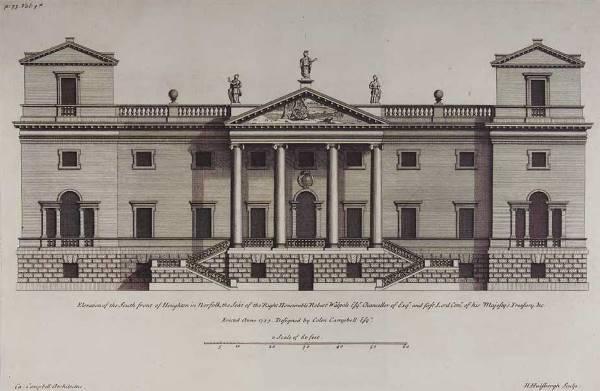
A façade must have a clear central focus, defined by a principal door, and window above; therefore the true classical or Palladian house always has an odd number of bays, and a centre gable or pediment. Of course some very pretty houses have been constructed in violation of this rule, but even an unenlightened beholder will gravitate more to the example which obeys it over the one which scarcely attempts it.


This is James Gibbs' rendering of Houghton Hall, for PM Robert Walpole, 1728.
As built, the towers were altered.


Having been of an 18th-century mentality for all of my adult life, even before I fully grasped the philosophy, the ideals of Palladio and Gibbs always came naturally to me. As a designer I have always pursued balance and symmetry. This is not to say I have never drawn an asymmetrical house; but no-one can argue that even an asymmetrical layout can be extremely fetching when correctly balanced. It takes very little effort to arrange windows and doors on the outside and archways and hallways on the inside with some sense of organisational balance, yet I cringe to the very point of nausea to see so many basic rules of art rashly and rudely violated by modern residential designers.

I once believed that with the advent of computer-aided design had come a generation of keyboard-poking simpletons who had never even touched carpentry tools and concocted houses with no regard to ease of construction or æsthetics. It seemed to me that the computer must have made it very easy to draw shapes and spaces which were in no thematic relation to each other, but merely jumbled together in some kind of floor plan and decorated on the outside with whatever windows from whose manufacturers the scofflaw received the most free cocktails. The carpenters would swear and scratch heads and sling hammers about in disbelief and frustration till they would arrive at some framing shortcut by which they could actually execute such an implausible design, and then, the last vestiges of their true joinery skills rapidly eroding, merely slap up whatever gaudy trim they could over the sheetrock and cover all the seams in the waferboard sheathing with vinyl siding, ever prudent enough to add the hassle factor into the builder’s fee.


Inexcusably hideous. Even the least bit of effort by the designer would have improved it.


Common sense. Tell me this wouldn't be the most tasteful house on your block
- and inexpensive and roomy as well.
This is the authentic 1930s recreation of William Penn's Pennsbury Manor, 1682.


Then I began designing on the computer myself. And I discovered that not only was it easy to draw straightforward plans that would be simple to build and pleasing to the eye, but that it was downright difficult not to. In fact any idiot, with no faculties other than the ability to manipulate keyboard and mouse and the knowledge of proper architectural conventions, can design a beautiful dwelling in just a few evenings. With my own experience as draughtsman in naval architecture and 25 years of study in residential design, I had only to get comfortable with the idiosyncrasies of the design programme itself, and go to work. In theory, and often in actual practice, I need only to draw the basic structural partitions of half the house, and simply copy-and-paste the half to the other side and reverse it left-to-right. The duplication inherent in a classically symmetrical plan actually pays its dues to the architect, and thence, to the surveyor, the carpenter, the builder, the bank, and the admiring neighbourhood.

Even on asymmetrical designs I begin by fixing X and Y datum lines, which are nearly always the centreline of the crosswise ridgepole and the centre of the principal doorway. These two elements are so fundamental that their location and relation to each other govern everything else to be drawn. I seriously and sadly doubt that most fools responsible for modern residences could even conceive of such a concept, let alone strike such lines by eye on one of their finished houses– more for which we should pity the carpenters.


This is too much the norm in the northeastern US--
a fool's attempt at imposing a self-determined 'style'.


All of this has lead me to only one possible conclusion: that the perpetrators of these obnoxious late-1900s monstrosities are consciously, deliberately drawing them to be what they appear to us from the kerb. But to what purpose? Given the choice of a lovely symmetrical Palladian manor, can any man worth his salt truly prefer such an incomprehensible amogon?

I used to drive to work past a housing tract, dreading the ride every day because of the extreme ugliness of the erections under construction, till one day I said aloud in the car, ‘If the kid who designed these things were my draughtsmanship student, and submitted one of these for a project, I’d fail him for the course on the spot!’ That served to put it better in perspective for me, and I resolved to write as much as I could on the subject for the rest of my life if need be.

The Prince of Wales, a great advocate of propriety in architecture, lamented in his 1985 A Vision of Britain that there are no degree programmes in the Realm today which provide architecture students with formal training in the classics. I found this incredible, and deplorable. We in this age have become so protective and even venerating of individual right to expression, no matter how inappropriate or offensive, that we have completely lost sight of the greater callings in society. The Augustan sensibility views architecture as a public profession, whose methods and fruits are exhibited to the whole world. A new structure must clearly perform some philosophical function for society. It must satisfy the wealthy and powerful that its beauty is appropriate for its overall purpose and the money invested in it. It must also impress the poor and helpless with a sense of awe at its majesty, no less than would a member of royalty in their midst, and also give them comfort, that their social betters are in possession of faculties befitting their station. All art is, after all, fundamentally intellectual, and no poor serf ever wants to think his overseers are intellectual idiots.

In America, unfortunately, intellectual idiocy is almost a required condition for membership. It seems that the richer one is, the more outlandish and obnoxious his taste, especially in the bigger things of his life, such as his houses. A poor man’s plain frame farm cottage is infinitely more elegant and appealing in its simplicity than the ostentatious palace of the most precipitously upwardly-mobile investment broker. When I wince, with agitated innards, at the garish treatment of windows and doors and cornices and gables on some of these typically American temples of impropriety, I often wish I could knock up one of the self-important owners and ask, ‘Why have you put on your modern stucco house vinyl louvred shutter appliques beside a wide window they could not possibly cover?’ To which he would undoubtedly answer, ‘Well, for looks, of course.’ –which would thus show him to be in deliberate violation of the prime maxim of design, as so succinctly put by the immortal yacht designer L Francis Herreschoff:

‘That which is put on merely for style has no style.’


Classic American style: Semple House, Williamsburg, c.1770.
Attributed to Thomas Jefferson, gentleman architect.
(Obviously a debt to Palladio.)


No style at all. (What are the shutters on it for, again?)


Ostentation which serves no valid artistic purpose is always needless and usually even destructive to the whole. Perhaps in the obvious parallels to late-20th-century narcotics use we might begin to decipher why it is so prevalent in spite of itself.

Always the unanswered question to me is, ‘So
who are these idiots really fooling?’ Then the immediately succeeding wonder is, ‘And how can I, who am of no moment, know these things, when educated men with degrees and formal credentials in design and construction and marketing and municipal zoning so obviously do not?’ As one of no great means it always gives me great trepidation to contemplate these mighty things, and I know I end up sounding self-pitying and antisocial when I proclaim to the so-called Powers That Be what seem like irrelevant working-class sympathies.


And so I willingly, soberly, happily, take a narrow, judgemental, even arrogant stance on the subject of residential design, and declare the far-too-frequent aberration in waferboard and vinyl to be entirely, irrevocably, and unforgivably wrong, and propose from my own hand the very alternative, that is, eminently practical plans of my own devisement which, I hope the thinking public and posterity will agree, are now, always will be, and should always have been wha
t any intelligent person considers proper, elegant, and universally amenable to the eye, the heart, and the purse. The contents of this collection are for those who will receive them in the spirit intended; that is, that they are not really of my doing, nor for my own glory, but, in aggregate, the statement of what has always been considered by the true classical sensibility as good and wholesome and right, and that, in the same way my noble predecessor James Gibbs offered the fruits of his studies, I offer mine to the thinking individual of this and any age who has either no trust in or no access to local architectural counsel, yet earnestly desires a residence of quality, of which all his family and neighbours, present and future, can always be proud. Friend, let me be your lampman. I am,

Your devoted servant,

J Comet, ESQ.


* * *

On Harry Wu released from Chinese prison.

Fortunate son... 

Jonnie Comet
31 August 1995 


  The release of Harry Wu from China last week  is indeed good news, but it is certainly not the end of the issue. Mr Wu has turned even more light on the actual state of human rights in China.  I find it appalling that industrialists and consumers in the land of the free are happy to turn a blind eye to these injustices, so long as profits remain high and products are marketable.  How many inexpensive consumer goods do we know that are made by the labor farms Mr Wu was trying to expose? It’s too hard to believe that Disney and McDonald’s and other marketers of Chinese-made plastic toys are unaware of how the Chinese government coerces their own population into contributing to the GNP. It is not only injustices against human beings that the Chinese have committed.  As an electronics buyer a few years back I was shocked at how well carried it was that the Chinese PC-board manufacturers habitually dump all their freon and other by-products directly into the rivers which peasants use for untreated drinking water.  In this way the Chinese government epitomizes the me-first attitude of turning a buck no matter what the cost to their neighbors or their own environment. Is this an organization to whom we as conscientious consumers really want to give our hard-earned money?
  I am sure most people in the US have no idea how bad it is for people in China. Harry Wu went there to show us.  You see, the People’s Republic of China is not really a communism.  In true communism, the people work together, and the people have bread. The current regime in China rose to power in 1949 on the platform that the people shall have bread; but they still don’t have it.  Those in this country who would have more government intervention would be wise to study the Chinese as they really are, as Wu attempted to show us. In a totalitarian state, no activity which is not sanctioned by the government is considered legitimate.   There is no free press– this includes Wu’s freelance research.   Therefore, in the eye of the Chinese government, he was gathering intelligence about them without permission, which is spying, and so the Chinese feel they are right to try him for it.   It’s painfully obvious that their clemency was only motivated by a need to keep as many American investors with blinders on in their country as they can.  After all, they do fear the American consumer public, and they know that a boycott of Chinese products, while difficult for us, would be catastrophic to the way of life which the people in power in China now enjoy at the expense of their comrades. That’s something to think about.
  All is not in vain. I submit that 50 years of the misnamed ‘People’s Republic’ is a very short span of time in the history of humankind for a population to be kept powerless and in the dark by a small group of self-serving bureaucrats.  The Soviets proved it would not last 75 years.  Harry Wu will go on to be denigrated and spat upon by his native country, until one day, when his labors will see fruition. Take heart, dear Mr Wu– you are in good company.  The apostle Paul was once persecuted by his own people too.  And Mandela.  And Walsea.  And King.


* * *