Showing posts with label design. Show all posts

Sunday, October 7, 2012

The textbook cure for student scoliosis.

Jonnie Comet 
13 April 1999

  
Recently a large body of middle-school students was assigned an essay in which they would make a rational case for or against the institution of homework. An articulate majority grant that homework is somehow necessary, but a good percentage suggest that one of its major drawbacks is the undue weight of materials they must take home in order to complete the work. It seems at once amusing and alarming to see that for this group of 11- to 13-year-olds, the I word scoliosis is hardly ever misspelt, as though it has become a well-used staple of their schoolgoing vocabulary.  
  Despite their exaggerations, the students are correct in assuming their backpacks are too heavy. The medical profession will allow that anything approaching 15 or 20 percent of the carrier’s own weight is unacceptably heavy a burden for one whose spine is not yet grown to adult strength. This would suggest that a backpack regularly carried at 15 pounds– more common than educators would care to believe (several essay respondents had even weighed their backpacks before, just out of morbid curiosity) –is likely to injure a 13-year-old child permanently. I am sure few school districts want the moral responsibility, let alone the legal one, when, ten years hence, the proof of spinal damage and the cost of its lifelong treatment come back to cleverly implicate a school policy or particular instructor.
  We’ve all heard these things before. Unfortunately the advent of the hiker’s rucksack, or backpack, as a de rigueur accessory for the secondary-school student, has exacerbated the problem considerably. Yet one cannot deny, at least through the students’ eyes, the perceived utility of the backpack for carrying a large load of odious gear to and from a place they would rather not be sent.  The concept of homework cannot be eliminated either, for if the US is to best the academic standards now being set by other nations, American students will have to accept the fact of independent review and practice outside the classroom.
  In spite of the Internet and other forms of immediate, non-printed material, the bound book in some form will likely be around for a long time to come. In itself it is infinitely cheaper and easier to access, transport, exchange, annotate by hand, and reproduce in ready form than other forms of media. Electronic media may be coming down in cost, but let’s face it– not all literature will ever really warrant the electronic process needed to get its text onto ROM, and then require that some form of data transfer apparatus be provided for it and carried round for whenever a reader wants to read on the bus or the beach. Moreover, for the teacher of other than reading subjects, electronic text may not facilitate a means for the student to respond in the way a paper-based worksheet does, nor make students’ independent progress so readily accessible to the teacher monitoring it in the classroom.
  No; I would say that at least for a short duration yet, the paper-based textbook-and-response method of student input and output will stay a fundamental part of the secondary-school homework model. To deliver students from the burden of weighty tomes, the answer must lie not in changing to an entirely new type of study material but in the nature of textbooks themselves.
  One has only to consider the typical secondary-school assigned textbook to see the point. I once taught a 11th-year literature class for which the school prescribed a huge heavy book two inches thick with everything from Beowulf to the Romantics in it. I despised the book and so did the students. I don’t think their hatred stemmed from the matter within the book as much as the thought of having to lug it round all day, although it certainly became an easy excuse not to have brought it to class and, more than once, initiated a change of plan for the day by their sympathetic teacher. Somehow the literature started to seem less important when I had to torture the poor kids into bringing it along.
  After reading the middle-school essays, I devised a very logical, cost-effective, and efficient alternative to books such as these. It seems so obvious I can only wonder why it is not widely used, as the evidence suggests it is not. The idea is simple: change the textbook. Instead of providing one huge book with eight centuries of literature in it, why not provide eight books each covering a shorter period? The books would be done in a series, with study questions at the end of each reading from which the student could merely copy out to do his homework. Rather than a hard cover, each series book would have a quality soft cover, possibly laminated to endure half a dozen years of use.
  The implications for the classroom teacher are unobtrusive as to be barely existent. At the start of each new unit the last unit-book would be collected and the new unit-books distributed. Thus for each subject the student would be assigned to take home only a 3/8-inch-thick soft-cover book, which would contain all the texts and exercises necessary for the unit at hand in the classroom. Printed at 8-1/2 x 11 inches, prepunched, five or six could be carried by the student in a single 2-inch D-ring binder. Though bulky in itself, any one student’s collection in one easy-to-handle package would never approach the combined weight of five subjects’ textbooks all burdened with information not needed at present which burden the student almost daily.
  There would be equal benefits for all subjects, even art and PE. I realise the unit-book idea could tend to perpetuate discrete skill building and lesson planning, which have begun to go out of favour in some schools and mostly with good reason. But for the vast majority of real classroom situations, few lesson plans are so comprehensive that pages from diverse places in the same large textbook are required regularly. Holistic summary could be provided by a data review or concept analysis section included at the close of each unit-book, or in the odd occasion via photocopy– since it is only what the students have seen before anyway. Better would be more teacher-devised assignments such as open-ended essay analysis and synthesis responses, the kind of thing too often overlooked even when suggested in the teacher’s guide of a big comprehensive textbook.
  It would be sheer folly for any instructor to merely teach and review a unit in isolation anyway and surely a death-knell for this unit-book idea. But the unit-books are only intended to replace the physical format of the textbook, and not the text-based learning model. They do not preclude the requirement that students take their own notes or accept reading and writing assignments independent of the formal text in whatever form it appears. In my estimation it is only the laziest and most unworthy of teachers who follows the traditional textbook so blindly as to become one with its limitations.
  I fear that the greatest drawback to the unit-book idea may lie not with educators but with publishers and the school administrators who buy from them. Any new idea is bound to be perceived as comparatively expensive and hassle-prone at first. But a long run of many paperback books selling for five dollars each, each used by a student only over a five-week period each year, must prove thriftier than one-eighth that order of heavy hardcover books at $40 or more each whose shipping costs alone make them undesirable. In fact since the unit-books are needed only in stages, the wise school buyer will schedule them to arrive one unit per month, so as to spread cost outlay over a school year. Over a period of five years five subjects could be thus integrated into the unit-book plan, at which time the first one may need replacement of texts, and so a school would merely have to ensure that the right books in the right quantities arrive every month, ad infinitum. The ongoing supplier-customer rapport this establishes can only be good in the long haul.
  One benefit to the unit-book plan is the ease with which texts can be updated. If and when revisions become necessary, only the affected one of the unit-books has to be revised and re-released into the rest of the set. This must be more reasonable than selling off the ‘old’ stock to less-savvy schools who, when they realise they have just missed getting a newer edition, will feel cheated out of their money and a good chunk of it too.
  Another great potential is for the integration of subjects within a level of study. The publisher can produce subject unit texts and lessons which are discrete yet interrelated. With the student having five or six similar-looking, colour-coded unit-books in his binder, he can recognise the interdependency of his subjects unit by unit. When the same terms and concepts are being learned and applied, the reinforcement in all subjects across the board will be overtly positive. The student will correctly spell scoliosis now because he has seen it in his language-arts spelling list and studied its cultural and anatomical aspects in social-studies and science. If just one child never has to learn the word by personal experience, the unit-book concept will have paid its due.
  It has long been my belief that a book more easily carried is more likely to be often read. It might seem almost too much to ask, but it is entirely possible that with proper lesson planning, the unit-book concept may help students leave off their wholesale disdain of texts and begin to look forward to receiving a new one every five weeks.


* * *

In pursuit of Palladio.

The philosophical foundation of a lifetime’s study in architectural design.


Jonnie Comet
1 January 1997


The great Andrea Palladio (1508-1580) is usually considered the father of what we now popularly call classical architecture. Through his study of ancient Roman models, he revived the symmetrical ideal and defined such classical architectural elements as the pedimented gable, the column, and the Venetian arch-top window that came to be known by his name.

Inigo Jones, Christopher Wren, John Vanbrugh and Colen Campbell, all major figures in Neoclassical architecture, were devoted scholars of the Palladian manner. During the early 1700s James Gibbs made several extended pilgrimages to Italy to study the work of Palladio and returned to London to explain, in writing and in plan, the ideals to which all architects and builders were to aspire. In his 1725 A Book of Architecture, he provides beautifully detailed descriptions and drawings of gates, fences, obelisks, columns, doors, windows, pediments, as well as dozens of plans for residences, churches, public halls, and their outbuildings. He presents himself in his foreword as a scholar, not a creator, and a public servant, not a self-concerned artist. The designs are offered as models which the thinking individual in the country who, having no benefit of local architectural counsel but desiring a proper edifice to confirm his station as a gentleman of quality, can consult for inspiration and direction.

To prescribe rules for art seems pompous, arrogant, and confining to modern Western thinking. In the late 20th century we have each grown accustomed to having our own way and letting the opinion of the public consensus be damned. In the 18th century, with its profound emphasis on propriety and posterity, such advice as Gibbs offered was welcomed with great enthusiasm. He became one of the most respected and beloved architects of all time, and A Book of Architecture was in every erudite Englishman’s library. It also sold well in the Americas, and while it seems none of his designs were ever substantially executed in the Colonies, the volume was an indispensable reference source for the designers and renovators of churches, residences, and public buildings– including Philadelphia’s Independence Hall.

The Palladian concept as touted by Gibbs requires several key design elements; to ignore or be ignorant of them is considered, to the classical sensibility, as a serious artistic and even societal faux pas. In his foreword Gibbs cautions that more than one builder who assumed his own personal expertise in design without benefit of serious study ended up with a structure so grotesque to the propriety-minded eye that the builder was shunned by quality society, causing him great expense both to his reputation and, through the resulting necessity of remedial renovations to the offending creation, his purse as well. Balance in style is, after all, simply both artistically and practically sensible.

To start, the true Palladian house must be symmetrical. Obvious imbalance always distracts and discomforts a beholder, even when he does not realise why. Proportions of windows, doors, pavilions, pediments, dependencies, columns, rooflines, arches, chimneys, interior panelling and finish, as well as the rooms themselves and the general layout of the building, are all governed by strict artistic maxims. The plans in Gibbs’ book are in fact so reliably symmetrical that he dimensions only one room in four, since those at the other corners may be assumed identical, or gives a depth only to one side of a corridor, for the corridor must certainly be on centre. Perfection in balance is maintained front-to-back, side-to-side, from room to room, and within each room. Blatantly disregarding this rule, your house should be considered at best a compromise, at worst, a failure.

Dependencies, if not perfectly symmetrical, must at least approach symmetry through equivalent balance; in pure theory, this rule extends to the gardens, walls, landscaping, and even the lay of the land where at all possible. The famous 18th-century groundsman Lancelot ‘Capability’ Brown capitalised on the gentry’s craving for structure and symmetry, and was immortalised not only in the hundreds of his gardens which still survive in England, but by respectful mentions in the vaunted novels of propriety priestess Jane Austen (notably Mansfield Park. --JC).

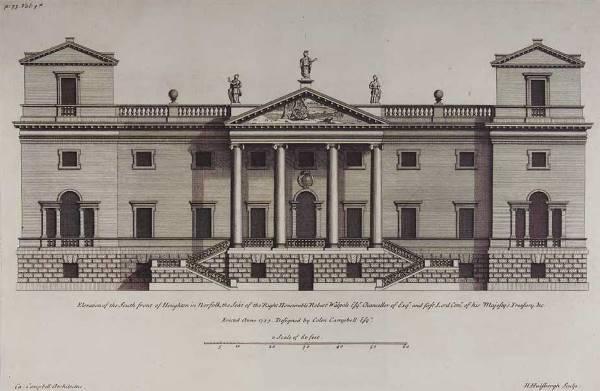
A façade must have a clear central focus, defined by a principal door, and window above; therefore the true classical or Palladian house always has an odd number of bays, and a centre gable or pediment. Of course some very pretty houses have been constructed in violation of this rule, but even an unenlightened beholder will gravitate more to the example which obeys it over the one which scarcely attempts it.


This is James Gibbs' rendering of Houghton Hall, for PM Robert Walpole, 1728.
As built, the towers were altered.


Having been of an 18th-century mentality for all of my adult life, even before I fully grasped the philosophy, the ideals of Palladio and Gibbs always came naturally to me. As a designer I have always pursued balance and symmetry. This is not to say I have never drawn an asymmetrical house; but no-one can argue that even an asymmetrical layout can be extremely fetching when correctly balanced. It takes very little effort to arrange windows and doors on the outside and archways and hallways on the inside with some sense of organisational balance, yet I cringe to the very point of nausea to see so many basic rules of art rashly and rudely violated by modern residential designers.

I once believed that with the advent of computer-aided design had come a generation of keyboard-poking simpletons who had never even touched carpentry tools and concocted houses with no regard to ease of construction or æsthetics. It seemed to me that the computer must have made it very easy to draw shapes and spaces which were in no thematic relation to each other, but merely jumbled together in some kind of floor plan and decorated on the outside with whatever windows from whose manufacturers the scofflaw received the most free cocktails. The carpenters would swear and scratch heads and sling hammers about in disbelief and frustration till they would arrive at some framing shortcut by which they could actually execute such an implausible design, and then, the last vestiges of their true joinery skills rapidly eroding, merely slap up whatever gaudy trim they could over the sheetrock and cover all the seams in the waferboard sheathing with vinyl siding, ever prudent enough to add the hassle factor into the builder’s fee.


Inexcusably hideous. Even the least bit of effort by the designer would have improved it.


Common sense. Tell me this wouldn't be the most tasteful house on your block
- and inexpensive and roomy as well.
This is the authentic 1930s recreation of William Penn's Pennsbury Manor, 1682.


Then I began designing on the computer myself. And I discovered that not only was it easy to draw straightforward plans that would be simple to build and pleasing to the eye, but that it was downright difficult not to. In fact any idiot, with no faculties other than the ability to manipulate keyboard and mouse and the knowledge of proper architectural conventions, can design a beautiful dwelling in just a few evenings. With my own experience as draughtsman in naval architecture and 25 years of study in residential design, I had only to get comfortable with the idiosyncrasies of the design programme itself, and go to work. In theory, and often in actual practice, I need only to draw the basic structural partitions of half the house, and simply copy-and-paste the half to the other side and reverse it left-to-right. The duplication inherent in a classically symmetrical plan actually pays its dues to the architect, and thence, to the surveyor, the carpenter, the builder, the bank, and the admiring neighbourhood.

Even on asymmetrical designs I begin by fixing X and Y datum lines, which are nearly always the centreline of the crosswise ridgepole and the centre of the principal doorway. These two elements are so fundamental that their location and relation to each other govern everything else to be drawn. I seriously and sadly doubt that most fools responsible for modern residences could even conceive of such a concept, let alone strike such lines by eye on one of their finished houses– more for which we should pity the carpenters.


This is too much the norm in the northeastern US--
a fool's attempt at imposing a self-determined 'style'.


All of this has lead me to only one possible conclusion: that the perpetrators of these obnoxious late-1900s monstrosities are consciously, deliberately drawing them to be what they appear to us from the kerb. But to what purpose? Given the choice of a lovely symmetrical Palladian manor, can any man worth his salt truly prefer such an incomprehensible amogon?

I used to drive to work past a housing tract, dreading the ride every day because of the extreme ugliness of the erections under construction, till one day I said aloud in the car, ‘If the kid who designed these things were my draughtsmanship student, and submitted one of these for a project, I’d fail him for the course on the spot!’ That served to put it better in perspective for me, and I resolved to write as much as I could on the subject for the rest of my life if need be.

The Prince of Wales, a great advocate of propriety in architecture, lamented in his 1985 A Vision of Britain that there are no degree programmes in the Realm today which provide architecture students with formal training in the classics. I found this incredible, and deplorable. We in this age have become so protective and even venerating of individual right to expression, no matter how inappropriate or offensive, that we have completely lost sight of the greater callings in society. The Augustan sensibility views architecture as a public profession, whose methods and fruits are exhibited to the whole world. A new structure must clearly perform some philosophical function for society. It must satisfy the wealthy and powerful that its beauty is appropriate for its overall purpose and the money invested in it. It must also impress the poor and helpless with a sense of awe at its majesty, no less than would a member of royalty in their midst, and also give them comfort, that their social betters are in possession of faculties befitting their station. All art is, after all, fundamentally intellectual, and no poor serf ever wants to think his overseers are intellectual idiots.

In America, unfortunately, intellectual idiocy is almost a required condition for membership. It seems that the richer one is, the more outlandish and obnoxious his taste, especially in the bigger things of his life, such as his houses. A poor man’s plain frame farm cottage is infinitely more elegant and appealing in its simplicity than the ostentatious palace of the most precipitously upwardly-mobile investment broker. When I wince, with agitated innards, at the garish treatment of windows and doors and cornices and gables on some of these typically American temples of impropriety, I often wish I could knock up one of the self-important owners and ask, ‘Why have you put on your modern stucco house vinyl louvred shutter appliques beside a wide window they could not possibly cover?’ To which he would undoubtedly answer, ‘Well, for looks, of course.’ –which would thus show him to be in deliberate violation of the prime maxim of design, as so succinctly put by the immortal yacht designer L Francis Herreschoff:

‘That which is put on merely for style has no style.’


Classic American style: Semple House, Williamsburg, c.1770.
Attributed to Thomas Jefferson, gentleman architect.
(Obviously a debt to Palladio.)


No style at all. (What are the shutters on it for, again?)


Ostentation which serves no valid artistic purpose is always needless and usually even destructive to the whole. Perhaps in the obvious parallels to late-20th-century narcotics use we might begin to decipher why it is so prevalent in spite of itself.

Always the unanswered question to me is, ‘So
who are these idiots really fooling?’ Then the immediately succeeding wonder is, ‘And how can I, who am of no moment, know these things, when educated men with degrees and formal credentials in design and construction and marketing and municipal zoning so obviously do not?’ As one of no great means it always gives me great trepidation to contemplate these mighty things, and I know I end up sounding self-pitying and antisocial when I proclaim to the so-called Powers That Be what seem like irrelevant working-class sympathies.


And so I willingly, soberly, happily, take a narrow, judgemental, even arrogant stance on the subject of residential design, and declare the far-too-frequent aberration in waferboard and vinyl to be entirely, irrevocably, and unforgivably wrong, and propose from my own hand the very alternative, that is, eminently practical plans of my own devisement which, I hope the thinking public and posterity will agree, are now, always will be, and should always have been wha
t any intelligent person considers proper, elegant, and universally amenable to the eye, the heart, and the purse. The contents of this collection are for those who will receive them in the spirit intended; that is, that they are not really of my doing, nor for my own glory, but, in aggregate, the statement of what has always been considered by the true classical sensibility as good and wholesome and right, and that, in the same way my noble predecessor James Gibbs offered the fruits of his studies, I offer mine to the thinking individual of this and any age who has either no trust in or no access to local architectural counsel, yet earnestly desires a residence of quality, of which all his family and neighbours, present and future, can always be proud. Friend, let me be your lampman. I am,

Your devoted servant,

J Comet, ESQ.


* * *