Showing posts with label architecture. Show all posts

Sunday, October 7, 2012

Farewell to the garden.


Jonnie Comet
20 May 1998


  My old school has died. I was by there today and stopped to look at it.  The grass has grown tall and the yard is littered with trash, not thrown there carelessly, only blown there by the weather and never taken up by the maintenance men.  There used to be dozens of maintenance men, every day, driving round in tall 4-wheel-drive Ford pickup trucks in dark red or dark green with ugly black wheels and tall skinny tyres.  The trucks all had manual shift– everyone drove manual shift back then. We used to see them creep by the windows when the guys were doing work in the yard, with the narrow lettering ‘Willingboro Township Public Schools’ stencilled proudly on the doors.  The guys wore work suits with their names on them and worked quietly– I do not remember ever hearing any of them yell out loud or swear during school hours.  They were hard-working men and reverent of the tasks they were performing.  They knew, as even we did, that they were doing them for us.
  We, the schoolchildren, were the pride of the whole township.  We came to the new development when it was still an experiment, and we proved the founding fathers (seems so strange calling men in their 30s and 40s ‘founding fathers’!) were right.  Our class in particular was the very elite, the creme de la creme of the entire district.  By the time we would graduate high school, there would be an even 1000 of us in all, having attended 13 elementary schools and two junior-high schools through 30-plus students per class and split sessions and intra-district busing and some of the most unconventional and even fanciful educational programmes the state had ever seen. By and large we excelled where educators expected only better-than-average; we were sought by university recruiters all over the country and were accepted wherever we chose.  We broke the mould and made a new one, and our aggregate achievement and attitude spoiled the teachers rotten forever.  As students in the township we were never to be rivalled.
  I walked up to the windows of the kindergarten wing, in the corridor on the way to the multipurpose room– there were only two kindergarten rooms, because in the days when this school was built mothers were home and there could be half-day sessions.  I was in K-2, in the afternoon class, because I was older and would not need a nap.  The last class of children painted flowers and grass on the inside of the windows, and little construction-paper clouds and suns dangle above them.  Inside, everything remains as I remember– the little ceramic water-fountain, the blue tile of the toilet, the grey marble of the wash-up sink, the light switches so close to the teacher’s closet door.  Above the three snaking rows of flimsy fluorescent lights, I measured the room by counting ceiling tiles– imagine a kindergarten classroom 26 by 40 feet!  It was immense– a whole world behind that polished birch door. In that world we learned common courtesy (there was such a thing then), and how to write our telephone numbers and addresses.  We heard stories and built with blocks and did not look under the girls’ dresses (little girls all wore dresses then).  The teacher kissed us goodbye when we left, and we knew it was not to be polite, but because we were loved.
  The floor looks original– brown and gold asphalt tile, incredibly well kept.  The room is set with half a dozen round or hexagonal tables and little chairs, as if pretending to ready for a class, but there are no other furnishings in the room now.  The tables are original– 37 years old at least! –faux white-ash Formica laminate over birch plywood, very heavy, with metallic pale-green steel legs, very Space Age, very stylish and state-of-the-art for institutional furniture in 1962.  In those days the idea of school as an ‘institution’ was still palatable.  It was the best example of an institution, where children were cherished and minds were moulded for the greater good of all society.  This is not to say that we were brainwashed– on the contrary.  We were nurtured.  Our mothers stayed home in their housedresses and shared coffee at ten and watched The Edge of Night at noon, and hung washing out back and hoovered the carpet and waxed the floors, and when we came home our bedrooms were tidied and our windows were open to the crisp October air and the house smelled fresh and clean and new, like it really was, the house and township and whole experience of what we were doing.  We had jelly sandwiches and changed into our play clothes and ran outside to do whatever it was all the other kids on the block were doing, since there were so many of them, Walt and Mike and Barry and Neil (or Ricky) and Elizabeth and Naomi and Paul and Robert and William and Brent and Cybil and Marcie and Jeff and Bobby and Gary and Bryan and Wayne and the entire extended neighbourhood.  We had more in common than we had differences; we had all moved in at the same time and wore the same kinds of clothes and spoke the same slang and watched the same TV programmes, and our fathers had all been in the same war.  Our fathers came home, one-by-one, from jobs in Philadelphia which could support their families in the lifestyle of their dreams, and one by one the kids of the neighbourhood would cry with joyous voice, ‘Daddy’s home!’ –and then every game would be split up till tomorrow, because there would be hugs or presents or news to share, and then dinner, then homework, then baths, and then another day of the same thing, all autumn and on through the winter and into the spring.
  When summer vacation came we fled the hallowed halls of our school, never appreciating that our own children would not know such comfort or sense of purpose.  We pretended to hate school, but inside perhaps we all knew that it was crucial to our well-being, and we all attended all the time.  We did homework and read the book and studied for tests.  When the teacher told us to sit, we sat.  We did not talk back.  Those who did were severely ostracised.  I can remember the horrid feeling of staying after school for some minor misinterpretation of the class rules (for none of us was ever truly bad), and sitting there alone in a quiet room with all the chairs put up on the desks, their metallic light-green legs surrounding me like some foreboding institutionalised forest, while the teacher worked quietly at the teacher’s desk, grading homework or quizzes and pretending not to notice how awful I felt, even as the tears of knowing I had somehow transgressed the boundaries of what was expected of me by the school and the teacher and my peers and my mother (worst of all!) streamed out of my eyes.  We all knew that there were expectations for us to meet, and we knew that meet them we surely must.  Dissent was unthinkable.  One day in fourth grade about twelve of us– almost half the class– decided en masse that we would rather play dodge-ball than report to choir practice, so when Mrs Joyce insisted we go, we rebelled by announcing we had all quit the choir. She gave us some very stern words of disapproval and made the defiant dozen sit silently in our seats, writing a three-paragraph essay on something like why things like choir are important, and none of us played dodge-ball that day– or failed to report to choir practice next week.  Thirty-five years hence, a teacher would have been hauled in front of a Board hearing for infringing upon our rights, and the ACLU would never have let go of it.
  The changes in educational philosophy have been dramatic, but they are not to blame for the closing of the old school.  With a mindset of centralisation and falling population, or falling school attendance, the township committee have obviously elected to let it die.  This is the new renewal theory: demolition by attrition.  J Cresswell Stuart Elementary School (named for the orchard grower whose lands made up most of the early development) is the oldest one in the township, needs plenty of maintenance and is now surrounded by shopping centres and too much traffic.  It has become redundant; and Willingboro has fiscal problems.  They need revenue desperately, and liabilities must be neutralised at any cost.
  Even so, however unsentimental, no councillor can ever happily sign an order to demolish a perfectly viable school.  It may not even matter if the accountants swear that removal of insulation or whatever will cost more than the building is worth as a community asset.  There is something profoundly disheartening about terminating a school building.  It represents the passing of something that can never measured in cash value nor superseded by something ‘new and improved’.  It is akin to the removal of a gravestone or the replacement of a wedding ring.  A school building is only so much brick and steel to one who never attended there.  But, to those who did, it is the very memorial in material form to what those experiences therein have wrought.
  As I peered in between the painted flowers on the windows, I noticed the clock is an hour off. It was never changed for daylight savings time.  It occurred to me that it will probably never be changed again.  No, I thought.  This place will never be brought up to the times.  Too much has changed already, and that time is gone forever.  The clock is a symbol of the school; it is slightly behind the time to which we have come now.  There is such a thing as progress, and such a thing as being stupidly uninterested in the values of the past.  Something transpired in this room long ago that can never be recaptured, if only because the people who could now effect it never went to school here. It is not part of their past, and so, as with too many Americans, the experience of someone else is irrelevant to them.  They are blind to anything but what they know personally.  They did not grow up in our class, where we learned to notice the world, inspect the world, understand the world– the whole world, as far as Telstar and Cape Canaveral and Vistadome and Chromacolor could help us see.  If we were a homogeneous community, at least we were an educated and enlightened one.  Our parents chose this township and this school for us because they knew better.  They chose for us a life better than the lives they might have known, a township where their values could remain secure while the prospects for their children could be broadened.  Their houses were not ‘investment property’ for them– they were our homes.  We went to school because we were raised to believe school was important, not because it was a place for childminders to deposit us on the way to work.  We belonged in school– there was simply never a question about that.  Our school was our garden, where we were fed and cared for and nurtured, and, when necessary, pruned back a little; and we always knew, though we never consciously acknowledged it, that one day we would no longer be physically part of the garden, but that the garden would always still be there, bearing at least some small reminder of having known our presence there, just as we would forever bear the fruits of having been there too.
  The yellow and green paint of the flowers painted on the windows has faded, having baked in the sun over a year now. I wondered if the children who painted them ever come back from wherever they are going to first grade now to see their handiwork, and what they think of its still being here, with no new children to see it and appreciate it. Then I worried about what will become of their painted garden into which they had put so much happy effort and which they had been so delighted to see every day. It was a difficult thought to consider for me, but I decided that someday, when the workmen come to dismantle the building, I hope they just accidentally break the glass and then have to get it out of the way without another thought. Who, who had ever been a kindergarten child, could bring himself to shatter those windows?


* * *

In pursuit of Palladio.

The philosophical foundation of a lifetime’s study in architectural design.


Jonnie Comet
1 January 1997


The great Andrea Palladio (1508-1580) is usually considered the father of what we now popularly call classical architecture. Through his study of ancient Roman models, he revived the symmetrical ideal and defined such classical architectural elements as the pedimented gable, the column, and the Venetian arch-top window that came to be known by his name.

Inigo Jones, Christopher Wren, John Vanbrugh and Colen Campbell, all major figures in Neoclassical architecture, were devoted scholars of the Palladian manner. During the early 1700s James Gibbs made several extended pilgrimages to Italy to study the work of Palladio and returned to London to explain, in writing and in plan, the ideals to which all architects and builders were to aspire. In his 1725 A Book of Architecture, he provides beautifully detailed descriptions and drawings of gates, fences, obelisks, columns, doors, windows, pediments, as well as dozens of plans for residences, churches, public halls, and their outbuildings. He presents himself in his foreword as a scholar, not a creator, and a public servant, not a self-concerned artist. The designs are offered as models which the thinking individual in the country who, having no benefit of local architectural counsel but desiring a proper edifice to confirm his station as a gentleman of quality, can consult for inspiration and direction.

To prescribe rules for art seems pompous, arrogant, and confining to modern Western thinking. In the late 20th century we have each grown accustomed to having our own way and letting the opinion of the public consensus be damned. In the 18th century, with its profound emphasis on propriety and posterity, such advice as Gibbs offered was welcomed with great enthusiasm. He became one of the most respected and beloved architects of all time, and A Book of Architecture was in every erudite Englishman’s library. It also sold well in the Americas, and while it seems none of his designs were ever substantially executed in the Colonies, the volume was an indispensable reference source for the designers and renovators of churches, residences, and public buildings– including Philadelphia’s Independence Hall.

The Palladian concept as touted by Gibbs requires several key design elements; to ignore or be ignorant of them is considered, to the classical sensibility, as a serious artistic and even societal faux pas. In his foreword Gibbs cautions that more than one builder who assumed his own personal expertise in design without benefit of serious study ended up with a structure so grotesque to the propriety-minded eye that the builder was shunned by quality society, causing him great expense both to his reputation and, through the resulting necessity of remedial renovations to the offending creation, his purse as well. Balance in style is, after all, simply both artistically and practically sensible.

To start, the true Palladian house must be symmetrical. Obvious imbalance always distracts and discomforts a beholder, even when he does not realise why. Proportions of windows, doors, pavilions, pediments, dependencies, columns, rooflines, arches, chimneys, interior panelling and finish, as well as the rooms themselves and the general layout of the building, are all governed by strict artistic maxims. The plans in Gibbs’ book are in fact so reliably symmetrical that he dimensions only one room in four, since those at the other corners may be assumed identical, or gives a depth only to one side of a corridor, for the corridor must certainly be on centre. Perfection in balance is maintained front-to-back, side-to-side, from room to room, and within each room. Blatantly disregarding this rule, your house should be considered at best a compromise, at worst, a failure.

Dependencies, if not perfectly symmetrical, must at least approach symmetry through equivalent balance; in pure theory, this rule extends to the gardens, walls, landscaping, and even the lay of the land where at all possible. The famous 18th-century groundsman Lancelot ‘Capability’ Brown capitalised on the gentry’s craving for structure and symmetry, and was immortalised not only in the hundreds of his gardens which still survive in England, but by respectful mentions in the vaunted novels of propriety priestess Jane Austen (notably Mansfield Park. --JC).

A façade must have a clear central focus, defined by a principal door, and window above; therefore the true classical or Palladian house always has an odd number of bays, and a centre gable or pediment. Of course some very pretty houses have been constructed in violation of this rule, but even an unenlightened beholder will gravitate more to the example which obeys it over the one which scarcely attempts it.


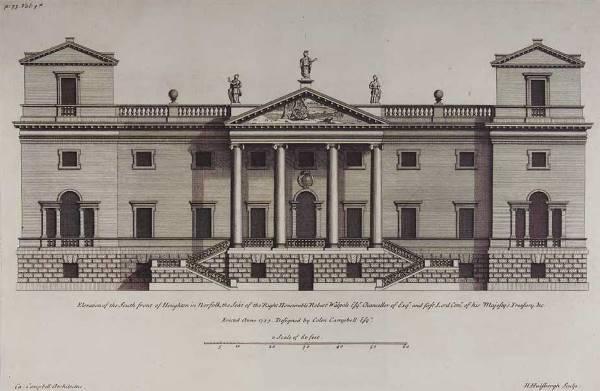
This is James Gibbs' rendering of Houghton Hall, for PM Robert Walpole, 1728.
As built, the towers were altered.


Having been of an 18th-century mentality for all of my adult life, even before I fully grasped the philosophy, the ideals of Palladio and Gibbs always came naturally to me. As a designer I have always pursued balance and symmetry. This is not to say I have never drawn an asymmetrical house; but no-one can argue that even an asymmetrical layout can be extremely fetching when correctly balanced. It takes very little effort to arrange windows and doors on the outside and archways and hallways on the inside with some sense of organisational balance, yet I cringe to the very point of nausea to see so many basic rules of art rashly and rudely violated by modern residential designers.

I once believed that with the advent of computer-aided design had come a generation of keyboard-poking simpletons who had never even touched carpentry tools and concocted houses with no regard to ease of construction or æsthetics. It seemed to me that the computer must have made it very easy to draw shapes and spaces which were in no thematic relation to each other, but merely jumbled together in some kind of floor plan and decorated on the outside with whatever windows from whose manufacturers the scofflaw received the most free cocktails. The carpenters would swear and scratch heads and sling hammers about in disbelief and frustration till they would arrive at some framing shortcut by which they could actually execute such an implausible design, and then, the last vestiges of their true joinery skills rapidly eroding, merely slap up whatever gaudy trim they could over the sheetrock and cover all the seams in the waferboard sheathing with vinyl siding, ever prudent enough to add the hassle factor into the builder’s fee.


Inexcusably hideous. Even the least bit of effort by the designer would have improved it.


Common sense. Tell me this wouldn't be the most tasteful house on your block
- and inexpensive and roomy as well.
This is the authentic 1930s recreation of William Penn's Pennsbury Manor, 1682.


Then I began designing on the computer myself. And I discovered that not only was it easy to draw straightforward plans that would be simple to build and pleasing to the eye, but that it was downright difficult not to. In fact any idiot, with no faculties other than the ability to manipulate keyboard and mouse and the knowledge of proper architectural conventions, can design a beautiful dwelling in just a few evenings. With my own experience as draughtsman in naval architecture and 25 years of study in residential design, I had only to get comfortable with the idiosyncrasies of the design programme itself, and go to work. In theory, and often in actual practice, I need only to draw the basic structural partitions of half the house, and simply copy-and-paste the half to the other side and reverse it left-to-right. The duplication inherent in a classically symmetrical plan actually pays its dues to the architect, and thence, to the surveyor, the carpenter, the builder, the bank, and the admiring neighbourhood.

Even on asymmetrical designs I begin by fixing X and Y datum lines, which are nearly always the centreline of the crosswise ridgepole and the centre of the principal doorway. These two elements are so fundamental that their location and relation to each other govern everything else to be drawn. I seriously and sadly doubt that most fools responsible for modern residences could even conceive of such a concept, let alone strike such lines by eye on one of their finished houses– more for which we should pity the carpenters.


This is too much the norm in the northeastern US--
a fool's attempt at imposing a self-determined 'style'.


All of this has lead me to only one possible conclusion: that the perpetrators of these obnoxious late-1900s monstrosities are consciously, deliberately drawing them to be what they appear to us from the kerb. But to what purpose? Given the choice of a lovely symmetrical Palladian manor, can any man worth his salt truly prefer such an incomprehensible amogon?

I used to drive to work past a housing tract, dreading the ride every day because of the extreme ugliness of the erections under construction, till one day I said aloud in the car, ‘If the kid who designed these things were my draughtsmanship student, and submitted one of these for a project, I’d fail him for the course on the spot!’ That served to put it better in perspective for me, and I resolved to write as much as I could on the subject for the rest of my life if need be.

The Prince of Wales, a great advocate of propriety in architecture, lamented in his 1985 A Vision of Britain that there are no degree programmes in the Realm today which provide architecture students with formal training in the classics. I found this incredible, and deplorable. We in this age have become so protective and even venerating of individual right to expression, no matter how inappropriate or offensive, that we have completely lost sight of the greater callings in society. The Augustan sensibility views architecture as a public profession, whose methods and fruits are exhibited to the whole world. A new structure must clearly perform some philosophical function for society. It must satisfy the wealthy and powerful that its beauty is appropriate for its overall purpose and the money invested in it. It must also impress the poor and helpless with a sense of awe at its majesty, no less than would a member of royalty in their midst, and also give them comfort, that their social betters are in possession of faculties befitting their station. All art is, after all, fundamentally intellectual, and no poor serf ever wants to think his overseers are intellectual idiots.

In America, unfortunately, intellectual idiocy is almost a required condition for membership. It seems that the richer one is, the more outlandish and obnoxious his taste, especially in the bigger things of his life, such as his houses. A poor man’s plain frame farm cottage is infinitely more elegant and appealing in its simplicity than the ostentatious palace of the most precipitously upwardly-mobile investment broker. When I wince, with agitated innards, at the garish treatment of windows and doors and cornices and gables on some of these typically American temples of impropriety, I often wish I could knock up one of the self-important owners and ask, ‘Why have you put on your modern stucco house vinyl louvred shutter appliques beside a wide window they could not possibly cover?’ To which he would undoubtedly answer, ‘Well, for looks, of course.’ –which would thus show him to be in deliberate violation of the prime maxim of design, as so succinctly put by the immortal yacht designer L Francis Herreschoff:

‘That which is put on merely for style has no style.’


Classic American style: Semple House, Williamsburg, c.1770.
Attributed to Thomas Jefferson, gentleman architect.
(Obviously a debt to Palladio.)


No style at all. (What are the shutters on it for, again?)


Ostentation which serves no valid artistic purpose is always needless and usually even destructive to the whole. Perhaps in the obvious parallels to late-20th-century narcotics use we might begin to decipher why it is so prevalent in spite of itself.

Always the unanswered question to me is, ‘So
who are these idiots really fooling?’ Then the immediately succeeding wonder is, ‘And how can I, who am of no moment, know these things, when educated men with degrees and formal credentials in design and construction and marketing and municipal zoning so obviously do not?’ As one of no great means it always gives me great trepidation to contemplate these mighty things, and I know I end up sounding self-pitying and antisocial when I proclaim to the so-called Powers That Be what seem like irrelevant working-class sympathies.


And so I willingly, soberly, happily, take a narrow, judgemental, even arrogant stance on the subject of residential design, and declare the far-too-frequent aberration in waferboard and vinyl to be entirely, irrevocably, and unforgivably wrong, and propose from my own hand the very alternative, that is, eminently practical plans of my own devisement which, I hope the thinking public and posterity will agree, are now, always will be, and should always have been wha
t any intelligent person considers proper, elegant, and universally amenable to the eye, the heart, and the purse. The contents of this collection are for those who will receive them in the spirit intended; that is, that they are not really of my doing, nor for my own glory, but, in aggregate, the statement of what has always been considered by the true classical sensibility as good and wholesome and right, and that, in the same way my noble predecessor James Gibbs offered the fruits of his studies, I offer mine to the thinking individual of this and any age who has either no trust in or no access to local architectural counsel, yet earnestly desires a residence of quality, of which all his family and neighbours, present and future, can always be proud. Friend, let me be your lampman. I am,

Your devoted servant,

J Comet, ESQ.


* * *